

Level 2 RC 08 — Can We Trust a Witness?

Updated: Sep 7
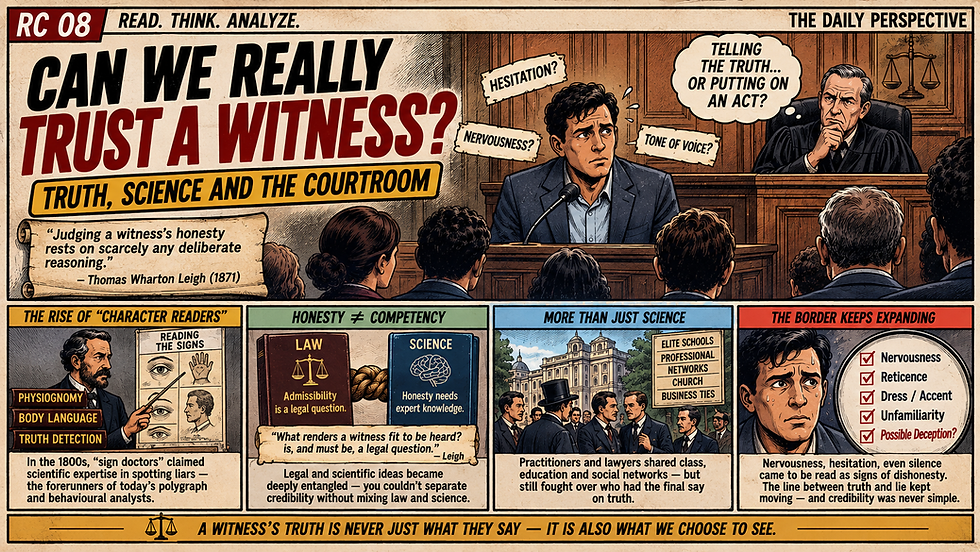
How can we know whether a witness is telling the truth, let alone prove it in court? In his 1871 treatise, Elements of Judicial Evidence, Thomas Wharton Leigh, among the most influential legal commentators of his generation, held that the assessment of a witness's veracity was an inference made with "scarcely any deliberate reasoning." In a civil or criminal trial, jurors, magistrates, and counsel could observe witnesses—noting their composure, hesitation, tone of voice—but the best they could hope for were signs. Rounding these signs up to a judgment about a witness's honesty was an act of intuition and habit. The closer the resemblance between witnesses and their jurors, the easier it was to overlook the gap that inference filled.
Conversely, when a witness struck jurors as unlike themselves, whether by dint of accent, dress, faith, or extraction, the precariousness of judgments about veracity was exposed.
In the latter half of the nineteenth century, practitioners who specialized in reading involuntary bodily signs held themselves out as experts in the new field of physiognomic science. Often called "character readers" or "sign doctors," they were the predecessors of modern polygraph examiners and behavioral analysts. The opinions of relatives and acquaintances had once been sufficient to separate honest witnesses from dishonest ones, but a growing belief that deception was a subtle condition requiring expert diagnosis pushed these practitioners into the witness box. Lawyers for both plaintiff and defendant began to recruit character readers to assess witnesses' honesty and to testify to it in court.
Dishonesty and incompetence to testify were not identical, however. Competency was a legal concept and not, fundamentally, a scientific one. Leigh explained: "The question 'What renders a witness fit to be heard?' is, and must be, a legal question. It cannot be anything else, for the meaning of competency is admissibility before the court." Nonetheless, scientific and legal accounts of what it meant to be a credible witness became entangled and mutually referential throughout the period. Lawyers relied on physiognomic knowledge to inform arguments about witnesses' honesty. Character readers commented on the legal weight of testimony. Ultimately, the fields of evidence law and character science were both invested in constructing an image of the trustworthy witness that could be contrasted with the deceptive one. This shared interest, and the shared space of the courtroom, made it nearly impossible to consider competency without science, or deception without law.
Practitioners and lawyers shared more than just concern for testimony. Class, education, and profession bound these middle-class, white, professional men together, as did family ties, civic loyalty, church membership, commercial partnerships, the alumni networks of elite academies, and structures of professional patronage. But for all their affinities, men of science and law were divided by contests over the borders of credibility, as much within each profession as between them. Character readers steadily pushed the boundaries of their field, developing increasingly complex and capacious taxonomies of deception. Nervousness and reticence came to be classified as signs of dishonesty, at least by some.
Q1. Study the following sets of concepts and identify the set that is conceptually closest to the concerns and arguments of the passage.
A) Judgement, Belief, Accounts, Patronage.
B) Intuition, Plaintiff, Knowledge, Commerce.
C) Assessment, Intuition, Plaintiff, Civic loyalty.
D) Judgement, Deception, Competency, Credibility.
Q2. "Conversely, when a witness struck jurors as unlike themselves, whether by dint of accent, dress, faith, or extraction, the precariousness of judgments about veracity was exposed." Which one of the following best describes the use of the word "extraction" in this sentence?
A) The witnesses were extracted from the courtroom by force during testimony.
B) Referring to the practice of tooth extraction, here it is used metaphorically to describe a painful cross-examination.
C) Referring to the witness's lineage or ancestry, here it is used as a marker of social or ethnic origin distinguishing the witness from the jurors.
D) Referring to the witness's confession of dishonesty, because 'dint' is an archaic form of 'didn't' or 'did not'.
Q3. The last paragraph of the passage refers to "middle-class, white, professional men". Which one of the following qualities best describes the connection among them?
A) Nervousness and reticence.
B) Intuition and habit.
C) Church membership, family ties, and professional patronage.
D) The opinions of relatives and acquaintances.
Q4. According to the passage, who or what was a "character reader"?
A) Practitioners who specialized in reading involuntary bodily signs to assess honesty in the nineteenth century.
B) Professionals who pushed the boundaries of their fields till they became unrecognizable in the nineteenth century.
C) Physicians and lawyers responsible for the character and conduct of new immigrants in the nineteenth century.
D) Practitioners responsible for compiling literary or biographical "character sketches" of witnesses for publication.
Q4 — Answer: A
· A is correct and is drawn directly from the text: "practitioners who specialised in reading involuntary bodily signs held themselves out as experts... Often called 'character readers'..."
· B misuses a phrase from para 4 ("pushed the boundaries of their field") out of context — the passage says they expanded their definitions, not that they became "unrecognisable."
· C and D both exploit the word "character" as a trap — C reroutes it toward an unrelated (invented) meaning about immigrants, and D reroutes it toward literary "character sketches," neither of which the passage supports; the term "character reader" in the passage refers strictly to reading a witness's honesty from bodily signs.
Q3 — Answer: C
· C is correct because it directly paraphrases the passage's own list of bonds: "family ties, civic loyalty, church membership, commercial partnerships... and structures of professional patronage" (para 4). This is the literal answer to "what connected these men."
· A ("Nervousness and reticence") describes symptoms character readers attributed to witnesses, not the bond between the professional men themselves.
· B ("Intuition and habit") describes the inferential process jurors used in para 1, unrelated to what bound this professional class together.
· D ("The opinions of relatives and acquaintances") describes the pre-expert method of judging honesty, mentioned in para 2 as something being displaced by the new experts — not a description of the professionals' shared bond.
Q2 — Answer: C
· C is correct. The sentence lists "accent, dress, faith, or extraction" as things by which a witness might strike jurors as "unlike themselves" — i.e., markers of social distance. In this list, "extraction" carries its older sense of lineage or ancestry (as in "of humble extraction"), fitting neatly alongside accent, dress, and faith as another social/ethnic marker.
· A takes "extraction" in its literal, physical sense (removing something by force), which makes no sense applied to witnesses in a courtroom passage about perception, not physical removal.
· B is a deliberately silly literal reading (dentistry) that has no support anywhere in the passage.
· D misreads "dint" (which genuinely means "by means of," an archaic usage) as…
Q1 — Answer: D
· D is correct. Judgement, deception, competency, and credibility are the passage's structural spine: para 1 is about judgement of veracity, para 2–3 about the science of detecting deception, para 3 explicitly defines competency as the legal concept, and the whole passage turns on how credibility is constructed. Every paragraph returns to these four terms.
· A mixes in "patronage," which appears only once, as one item in a background list of social bonds (para 4) — a peripheral detail, not a central concern.
· B and C both include "plaintiff," a purely functional courtroom term used once in passing; "commerce" and "civic loyalty" are likewise single-mention background details from the bonding list in para 4, not concepts the…